
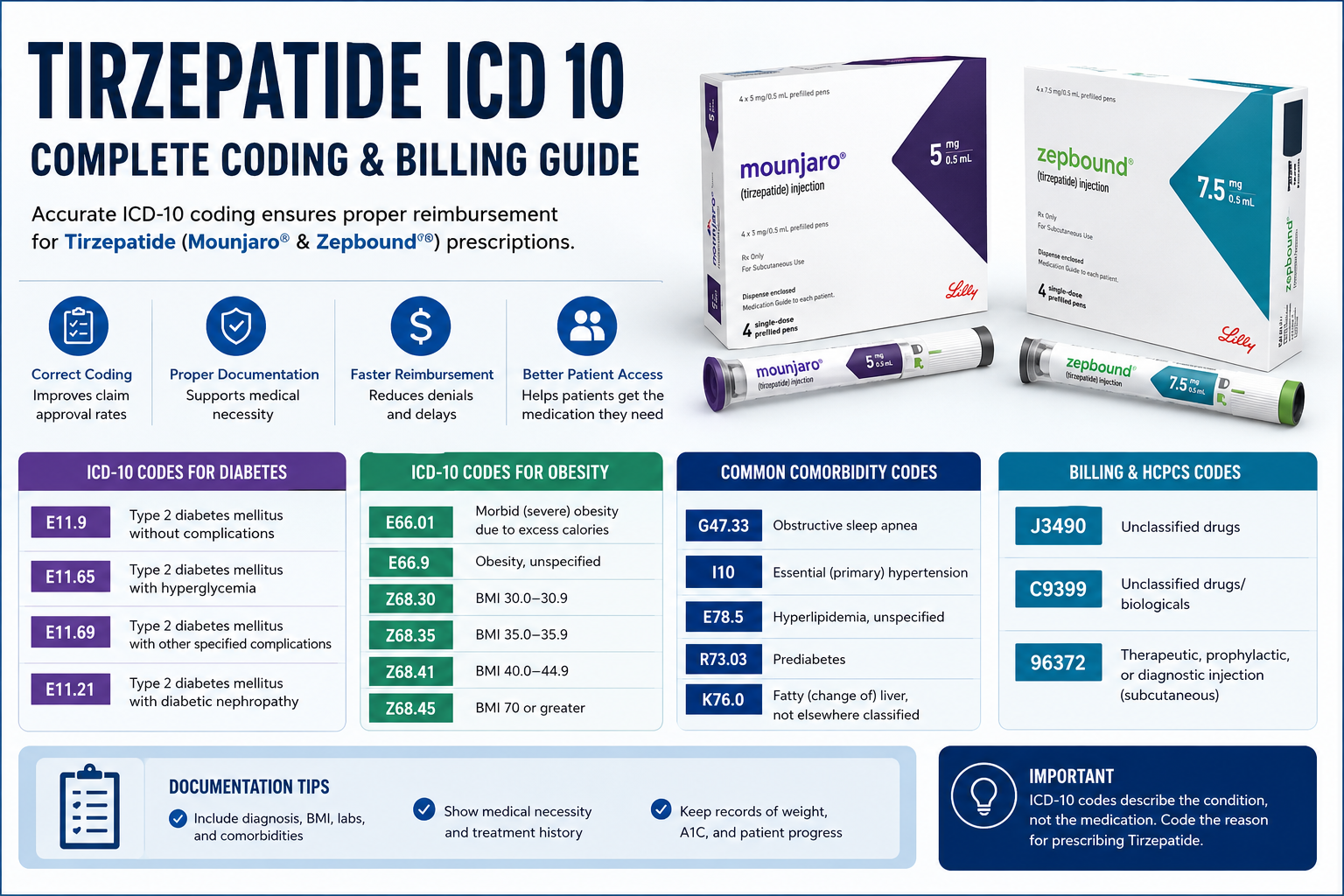
Tirzepatide has rapidly become one of the most discussed medications in healthcare, especially in the fields of medical billing, coding, obesity management, and diabetes treatment. With the growing popularity of medications like Mounjaro and Zepbound, healthcare providers, medical coders, and billing specialists are constantly searching for the correct tirzepatide ICD 10 codes for insurance claims, prior authorizations, and reimbursement approvals.
According to the Centers for Medicare & Medicaid Services (CMS), ICD-10 coding updates continue to evolve in 2026, making accurate diagnosis coding more important than ever for healthcare practices.
The challenge is that tirzepatide itself does not have one dedicated ICD-10 diagnosis code. Instead, the ICD-10 code depends entirely on why the medication is being prescribed. Is the patient using tirzepatide for obesity? Type 2 diabetes? Sleep apnea associated with obesity? Prediabetes? Each condition requires a different diagnosis code, and even a small coding mistake can lead to denied claims or rejected prior authorizations.
This guide breaks everything down in plain English so medical coders, billers, healthcare providers, and even patients can understand exactly how tirzepatide ICD-10 coding works in 2026.
FDA-Approved Tirzepatide Brands
Currently, tirzepatide is marketed primarily under two major brand names:
| Brand | Main FDA Approval | Primary ICD-10 Category |
|---|---|---|
| Mounjaro | Type 2 Diabetes | E11 series |
| Zepbound | Obesity & Weight Management | E66 series |
Although both medications contain the exact same active ingredient, insurance companies frequently process them differently because their FDA-approved indications are different.
Why ICD-10 Coding Matters for Tirzepatide
ICD-10 coding is essentially the “language” insurance companies use to understand why a medication is medically necessary. Without the correct diagnosis code, insurers may reject claims, deny prior authorizations, or refuse manufacturer savings programs.
Imagine trying to enter a secure building with the wrong access card. Even if you belong there, the system blocks you. That is exactly how insurance systems handle incorrect ICD-10 coding for tirzepatide prescriptions.
Insurance Reimbursement Challenges
Many insurance carriers now have strict requirements for GLP-1 and dual agonist medications because of their high costs and growing demand. A single missing BMI code or incorrect obesity diagnosis can result in claim rejection.
Prior Authorization Requirements
Prior authorization has become almost standard for tirzepatide prescriptions. Insurance companies often request:
- BMI documentation
- Obesity diagnosis codes
- Type 2 diabetes confirmation
- Comorbid condition documentation
- Failed treatment history
- Weight records
- Lab values such as A1C
If providers do not include the correct ICD-10 code combination, insurers can delay or deny prior authorization requests.
Does Tirzepatide Have Its Own ICD-10 Code?
No. Tirzepatide itself does not have a unique ICD-10 diagnosis code.
This is one of the biggest misconceptions among new medical billers and patients. ICD-10 codes describe the medical condition, not the medication itself. That means the code depends entirely on the diagnosis being treated.
For example:
- If tirzepatide is prescribed for diabetes, the diagnosis usually falls under the E11 category.
- If prescribed for obesity, coding typically falls under the E66 category.
- If tied to BMI documentation, additional Z68 codes may also be required.
Healthcare providers must always code the underlying condition rather than the drug name itself.
Tirzepatide ICD-10 Codes for Type 2 Diabetes
When tirzepatide is prescribed as Mounjaro for diabetes management, coders usually use ICD-10 codes from the E11 family.
Common E11 Codes
| ICD-10 Code | Description |
|---|---|
| E11.9 | Type 2 diabetes mellitus without complications |
| E11.65 | Type 2 diabetes mellitus with hyperglycemia |
| E11.69 | Type 2 diabetes mellitus with other specified complications |
| E11.21 | Type 2 diabetes mellitus with diabetic nephropathy |
These codes help insurers identify the severity and complexity of the diabetic condition. In many cases, additional documentation such as A1C levels or previous medication history may also be required.
Medical coders should always verify provider documentation carefully because insurers may reject vague or unsupported diabetes diagnoses.
Tirzepatide ICD-10 Codes for Obesity
Obesity coding is one of the most common billing pathways for tirzepatide, especially with Zepbound prescriptions.
E66.01 Morbid Obesity
BMI≥40BMI \geq 40
The ICD-10 code E66.01 refers to morbid or severe obesity due to excess calories. This code is commonly used when patients have extremely elevated BMI levels and qualify for medical weight management therapies.
Insurance companies frequently require accompanying BMI documentation using Z68 codes to support this diagnosis.
E66.9 Obesity Unspecified
Healthcare providers use the ICD-10 code E66.9 for obesity when they do not document a more specific classification.
Some insurers accept E66.9, but many payers prefer more detailed obesity classifications.
BMI Z68 Codes
BMI codes are extremely important in tirzepatide claims.
Examples include:
| BMI Code | Description |
|---|---|
| Z68.30 | BMI 30.0–30.9 |
| Z68.35 | BMI 35.0–35.9 |
| Z68.41 | BMI 40.0–44.9 |
| Z68.45 | BMI 70 or greater |
Think of BMI codes as the “evidence file” supporting obesity diagnoses.
ICD-10 Codes for Zepbound
Zepbound is primarily associated with obesity treatment and weight management coding.
Common diagnosis combinations include:
| ICD-10 Code | Description |
|---|---|
| E66.01 | Morbid obesity |
| E66.9 | Obesity unspecified |
| Z68.41 | BMI 40–44.9 |
| G47.33 | Obstructive sleep apnea |
Because obesity treatment coverage varies widely between insurers, accurate documentation is essential.
ICD-10 Codes for Mounjaro
Mounjaro is FDA-approved for type 2 diabetes treatment.
Common coding combinations include:
| ICD-10 Code | Description |
|---|---|
| E11.9 | Type 2 diabetes without complications |
| E11.65 | Type 2 diabetes with hyperglycemia |
| Z79.85 | Long-term use of injectable non-insulin antidiabetic drugs |
Insurers frequently require proof that the patient actually has type 2 diabetes before approving Mounjaro coverage.
Tirzepatide Billing and HCPCS Codes
ICD-10 codes explain the diagnosis, but billing also requires CPT and HCPCS coding.
J3490 and C9399
Recent billing guides indicate that tirzepatide currently lacks a dedicated J-code.
| HCPCS Code | Use |
|---|---|
| J3490 | Unclassified drugs |
| C9399 | Unclassified drugs/biologicals |
These codes are commonly used when billing tirzepatide under medical benefits.
CPT Code 96372
9637296372
Prior Authorization Tips for Tirzepatide
Prior authorization can feel like navigating a maze blindfolded. One missing document often resets the entire process.
Providers can improve approval success by including:
- Specific obesity classifications
- BMI documentation
- Weight history
- Diabetes lab values
- Comorbidity documentation
- Sleep apnea evidence
- Failed treatment attempts
Detailed documentation dramatically increases approval chances because insurers want evidence that tirzepatide is medically necessary.
Common ICD-10 Coding Errors
Coding mistakes happen more often than many clinics realize.
Common errors include:
| Error | Result |
|---|---|
| Missing BMI code | Prior authorization denial |
| Using vague obesity diagnosis | Delayed approval |
| Incorrect diabetes code | Insurance rejection |
| Missing supporting documentation | Pharmacy hold |
| Wrong brand indication | Savings card rejection |
Even experienced billers can struggle because obesity medicine coding continues evolving rapidly.
Obesity Coding Changes in 2026
Recent ICD-10 updates introduced more detailed obesity classifications.
This shift reflects a growing trend toward more precise obesity classification in healthcare reimbursement systems.
Healthcare providers should regularly monitor CMS updates because coding changes can directly affect reimbursement accuracy.
How Pharmacies Use Tirzepatide ICD-10 Codes
Pharmacies often require ICD-10 codes for manufacturer savings cards and insurance adjudication.
This requirement exists because manufacturers and insurers need confirmation that the medication matches approved indications.
Insurance Coverage Differences Between Mounjaro and Zepbound
One of the strangest realities in healthcare today is that two medications with the same active ingredient can have completely different insurance outcomes.
Patients may receive approval for Mounjaro under diabetes benefits but face denial for Zepbound under obesity exclusions.
That difference often comes down to ICD-10 coding.
Think of it like two identical cars entering different toll lanes. One lane is covered by insurance, while the other requires full payment.
Best Documentation Practices for Providers
Strong documentation is the foundation of successful tirzepatide billing.
Providers should include:
- Exact diagnosis
- BMI values
- Weight history
- Comorbidities
- Treatment goals
- Medication response
- Lifestyle counseling documentation
Detailed charting protects providers during audits while also supporting reimbursement accuracy.
Future of Tirzepatide Medical Coding
Tirzepatide coding will likely become more specialized as usage expands. New FDA indications, dedicated HCPCS codes, and additional obesity classifications may emerge over the next few years.
As obesity medicine becomes more mainstream, healthcare systems are shifting toward more precise metabolic disease coding rather than broad obesity categories.
Medical coders who stay updated with CMS and payer-specific policies will have a major advantage in the evolving reimbursement landscape.
Conclusion
Understanding tirzepatide ICD 10 coding is no longer optional for healthcare providers, medical billers, and coders. As medications like Mounjaro and Zepbound continue dominating obesity and diabetes treatment conversations, accurate coding becomes essential for reimbursement success.
The key takeaway is simple: tirzepatide itself does not have a dedicated ICD-10 diagnosis code. The condition determines the correct code, whether the patient has type 2 diabetes, obesity, sleep apnea, or another related disorder.
Healthcare professionals who combine precise ICD-10 coding with strong documentation and updated billing practices will experience fewer denials, smoother prior authorizations, and better reimbursement outcomes in 2026 and beyond.
FAQs
What is the ICD-10 code for tirzepatide?
There is no specific ICD-10 code for tirzepatide itself. The condition, such as obesity or type 2 diabetes, determines the diagnosis code.
What ICD-10 code is used for Zepbound?
Common codes include E66.01 for morbid obesity, E66.9 for obesity unspecified, and BMI-related Z68 codes.
What ICD-10 code is used for Mounjaro?
Mounjaro is usually billed with E11 category codes for type 2 diabetes mellitus.
Does tirzepatide have a J-code?
As of 2026, tirzepatide generally uses HCPCS codes J3490 or C9399 because there is no dedicated J-code yet.
Why do pharmacies ask for ICD-10 codes for tirzepatide?
Pharmacies often require ICD-10 codes for insurance claims, manufacturer savings cards, and prior authorization processing.